Homemade Lunchables: Less Money, Cleaner, and Your Kid Will Still Eat Them
DIY Lunchables cost about $1.20-1.60 vs $2.50-4.50 for the box, take 5 minutes, and cut the sodium. The formula, 4 kid-approved combos, and the math.
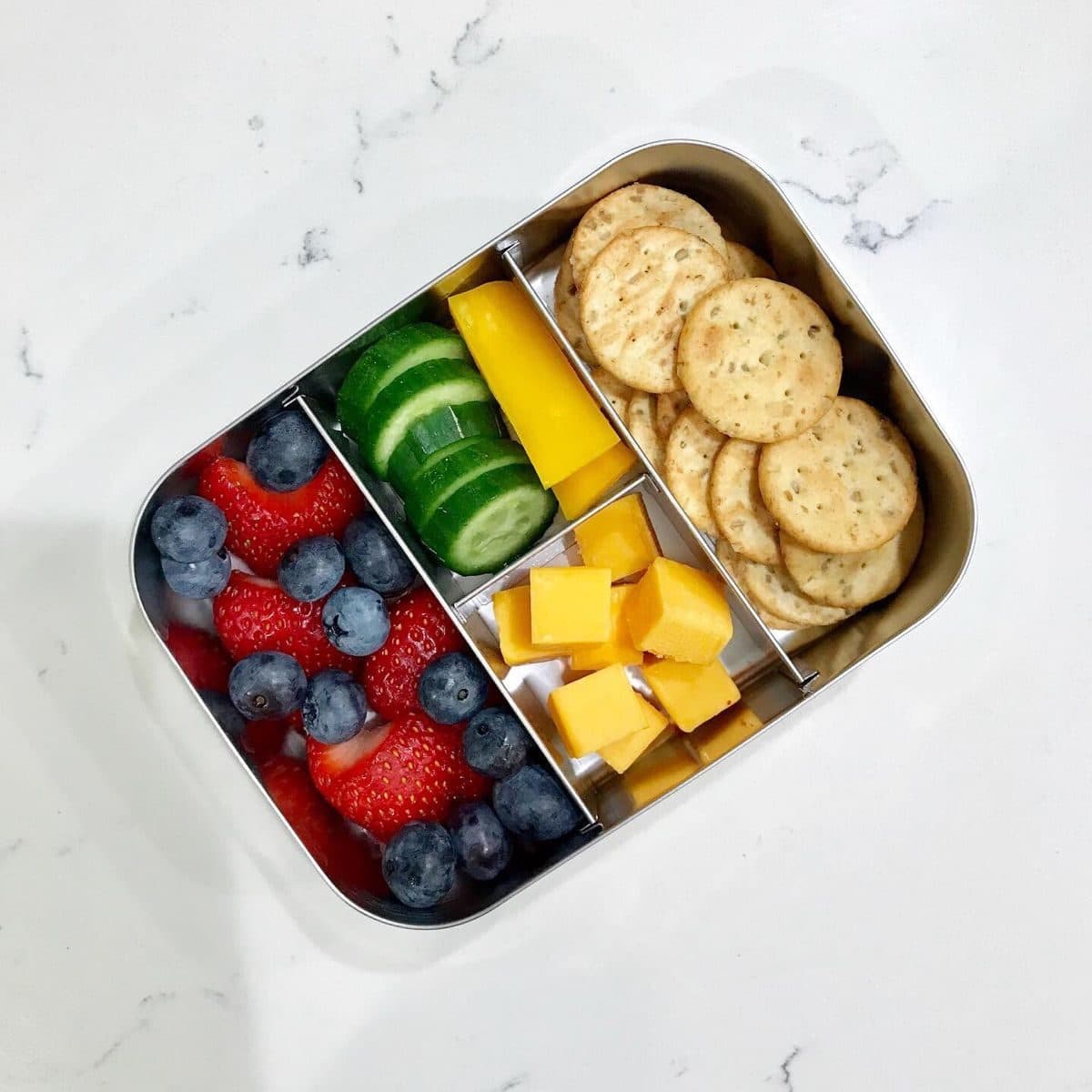
Yes, you can make Lunchables at home: about $1.20 to $1.60 per box vs $2.50 to $4.50 for the store version, about half the sodium, and roughly 5 minutes of assembly per box. Over a school year that's about $250 to $450 saved for one kid.
Before anything else: this is a no-shame zone. If you've been tossing the yellow box in the cart because it buys you 90 seconds of peace at 7am, you're doing fine. Convenience food exists because parenting is a lot. This post is just here to show you the convenience is surprisingly easy to clone.
What's actually in a Lunchables box?
Mostly normal food, delivered with a heavy pour of sodium and a long ingredient list. Stating it factually, without the scary music:
- Sodium is the headline. Several classic varieties land around 700 mg per box. For context, the FDA's guidance for adults is under 2,300 mg a day, and recommended limits for younger kids are lower, so one box can be about a third of a small kid's day.
- The meat is processed meat. The WHO's cancer agency classifies processed meat as a carcinogen when eaten regularly over time. That's a reason to make it an occasional player instead of a daily starter, and it applies to any deli meat, homemade stacks included.
- The ingredient list is long. A classic ham-and-cheddar box runs a few dozen ingredients once you count the crackers, each one required by FDA labeling rules to be listed in descending order by weight (fda.gov). The DIY equivalent is about 8. Additives in that gap are FDA-approved and mostly there for shelf life, which is a problem your refrigerator already solves for free. (If you enjoy decoding those labels, here's how to read them in 60 seconds.)
The box is no poison, just a product engineered to survive months on a shelf, being fed to a kid whose lunch only needs to survive until noon.
How do you make homemade lunchables kids will actually eat?
Use the formula. Every Lunchables-style box, store or homemade, is the same five slots:
Protein + cheese + carb + fruit or veg + tiny treat.
What kids actually love about Lunchables is compartments, small things, and stacking. Keep those three and you can swap every ingredient.
Four combo templates with a high acceptance rate in field testing (my field testers are children):
| Template | Protein | Cheese | Carb | Fruit/veg | Tiny treat |
|---|---|---|---|---|---|
| The Classic | Rolled turkey slices | Cheddar squares | Round crackers | Apple slices | 2 chocolate chips |
| Pizza Day | Pepperoni (or leftover chicken) | Mozzarella pearls | Mini pitas + spoon of sauce | Cherry tomatoes | Fruit gummy |
| The Dipper | Hummus | String cheese | Pretzel sticks | Cucumber coins | Mini cookie |
| Breakfast-for-lunch | Hard-boiled egg | Babybel | Mini pancakes or waffle pieces | Berries | Drizzle of syrup in a tiny cup |
Two execution notes. Cut the cheese into squares or use a small cutter, because shape is doing about 40 percent of the work here. And keep portions small: a kid lunch looks stingy to an adult, which usually means it's the right size.
A word on school rules: many classrooms are nut-free, which knocks out some obvious dipper fillings. Easy swaps that survive the rule sheet: sunflower seed butter for peanut butter, hummus or cream cheese as the dip, and roasted chickpeas for crunch. Same compartments, same acceptance rate.
And for the picky eater with a two-food rotation: keep 4 of the 5 slots identical to their known-safe foods and rotate only one slot per week. Kids accept one new thing sitting next to four familiar things at a much higher rate than a whole new box.
What is the 5-minute Sunday assembly system?
The store box's actual product is speed. Here's how you match it.
- Buy 4 to 5 bento boxes with fixed compartments ($15 to $25 for a set, a one-time buy). The compartments are the magic, don't skip them.
- Sunday, 20 minutes: cut the week's cheese and veg, boil eggs if using, portion crackers into a bin. Assemble 4 boxes assembly-line style.
- Refrigerate. Sealed boxes keep 3 to 4 days, which covers Monday through Thursday. Friday can be the store box, sandwich day, or hot lunch.
- Morning of: add crunchy items so they stay crisp, grab, go. That's your 90 seconds of peace, kept intact.
Rotate the four templates weekly and you've got a month before anyone claims boredom.
How much do homemade lunchables save?
The per-box math, using regular grocery prices:
| Store box | DIY box | |
|---|---|---|
| Cost per box | ~$2.50 to $4.50 | ~$1.20 to $1.60 |
| Sodium | up to ~700 mg | ~300 to 400 mg |
| Ingredients | a few dozen | ~8 |
| Prep time | 0 minutes | ~5 minutes |
| School-year cost (180 days) | ~$450 to $810 | ~$215 to $290 |
Call it roughly $250 to $450 back per school year for one kid, doubled for two. The DIY box saves about $1.30 to $2.90 every single school day, which is a better hourly rate than most side hustles once you're fast at assembly.
Here's the part that surprised me: every kid imprints on a specific variety. Yours might be loyal to the turkey stacker or the pizza one specifically, and the templates above are generic. That's the exact gap ApronUp fills: an iOS app that scans the box your kid actually loves and generates the matched copycat build, shows the additive comparison side by side as a clean score out of 100, and tracks what the swap saves you per month.
If this unlocks something in you, the same trick works on the whole snack aisle, and we collected 15 more easy copycats here.
Your first-week checklist
- Buy one set of compartment bento boxes (the compartments are non-negotiable, ask any 6-year-old)
- Pick 2 of the 4 templates, ideally one that mimics your kid's current favorite box
- Do one 20-minute Sunday assembly for 4 boxes
- Keep a store box or two in the fridge as backup, because some mornings win
- After 2 weeks, check the math: about $10 to $20 already stayed in your pocket
The kid gets compartments. You get the money and the shorter ingredient list. Everybody eats.
Quick answers
- Are Lunchables unhealthy?
- They're fine as an occasional lunch and less great as a daily one. Some varieties carry around 700 mg of sodium, roughly a third of a young kid's recommended daily limit, plus processed meat and a long additive list. The DIY version keeps the format kids love while cutting sodium roughly in half.
- How long do DIY lunchables keep in the fridge?
- 3 to 4 days refrigerated in a sealed bento box, which is why a 20-minute Sunday assembly covers Monday through Thursday. Keep cut fruit like apple slices tossed in a little lemon juice, and add anything crunchy (crackers, pretzels) the morning of so it stays crisp.
- How much do homemade lunchables save?
- Store boxes run about $2.50 to $4.50 depending on variety, and the DIY version costs about $1.20 to $1.60 per box. Over a 180-day school year that's roughly $250 to $450 saved for one kid, or about the price of a decent family weekend away.